
How to invest in Nepal from the US - and legally bring your money back

XunoApr 2026
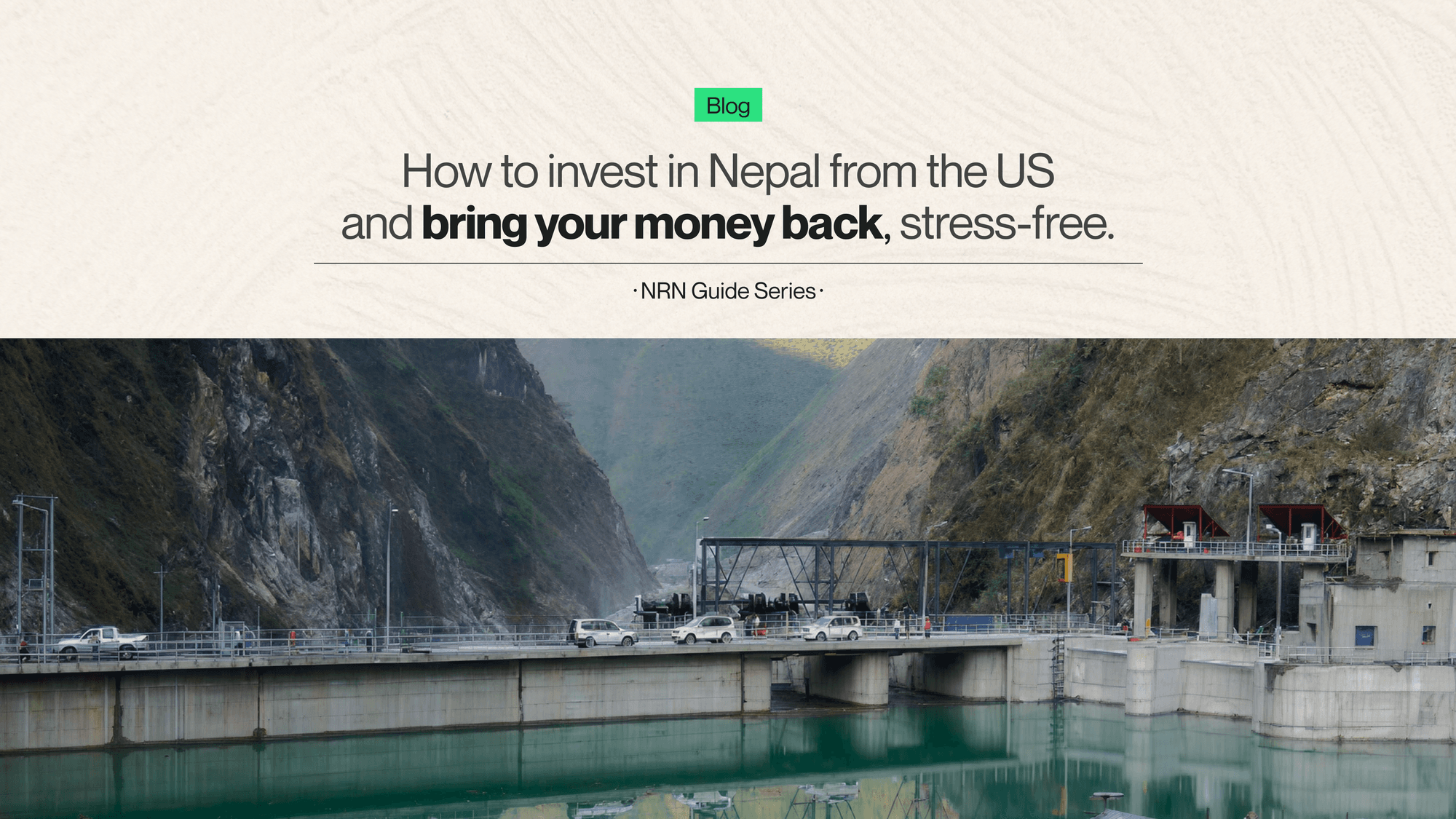
You’re in the US, you’ve saved up dollars, and somewhere in the back of your mind the question keeps coming up: can I actually invest in Nepal, grow it, and bring it back to the US when I need it?
Good news - you can. The tricky part is that this information is genuinely hard to find in one place. So we’ve put it all together here: how to invest, what documents actually matter, and exactly how repatriation works.
Step 1: First, get your NRN Identity Card
The NRN Identity Card is what officially recognizes you as a Non-Resident Nepali or a foreign citizen of Nepali origin. Under the Non-Resident Nepali Rules, 2064, it gives you the legal right to invest in Nepal, open foreign currency accounts, and eventually move those funds back abroad.
Without it, none of what follows is possible, so if you don’t have one yet, this is where to start.
Step 2: Open a USD fixed deposit account in Nepal
Once you have your NRN card, here’s how the money actually moves:
- Find a Nepali bank that accepts convertible foreign currency deposits and allows overseas transfers, not all banks offer this, so confirm before you open an account.
- Open a USD account at that bank.
- Transfer your money from your US bank to this Nepali USD account through official banking channels
- Once the funds arrive, lock them into a fixed deposit. The bank will give you documentation showing the amount, interest rate, and tenure - keep all of it.
Step 3: Make sure you get the Certificate of Capital Investment
This is the step most people don’t know about - and it’s the most important one. Under Rule 9 of the Non-Resident Nepali Rules 2066, your bank is required to issue you a Certificate of Capital Investment once your deposit is placed.
This certificate proves that your money entered Nepal legally through convertible foreign currency. It’s the document that makes repatriation possible later. Without it, getting your money back to the US becomes a lot more complicated. Ask for it explicitly, and once you have it, don’t just file it away, keep a digital backup too.
Good to know: How tax on your interest works
You don’t need to file or calculate anything yourself. When your fixed deposit earns interest, the bank automatically deducts 5% as withholding tax before crediting it to you.
While the bank handles the deduction, you’ll want to hold onto these documents, they’ll matter when it’s time to bring your money home:
- FD agreement
- Interest statements
- Certificate of Capital Investment
- Tax Clearance Certificate
This is also where having the right tools matters. Xuno helps NRNs move money across borders with full transparency. Hence, every dollar you send to Nepal is tracked, documented, and accounted for. You’re not just sending money home. You’re building something you can actually bring back.
Step 4: Ready to bring your money back? Here’s how repatriation
works
Before initiating any transfer abroad, you’ll need a Tax Clearance Certificate from Nepal’s Inland Revenue Department, this confirms that all taxes on your earnings have been settled. With that in hand, submit the following documents to your banks to request the transfer:
- NRN Identity Card
- FD agreement
- Certificate of Capital Investment
- Interest statements
- Tax Clearance Certificate
The bank reviews everything and processes the transfer. One rule worth knowing upfront: your funds can only be sent back to the same US bank account they originally came from. So when you’re setting up the investment, make sure that’s an account you’re planning to keep.
That’s the whole picture
Invest in Nepal from the US, earn interest, and bring it all back legally when you’re ready. It’s not a shortcut, it takes the right setup and the right documents - but it works, and it’s worth doing properly.
At Xuno, we’re building tools that make this kind of cross-border wealth creation cleaner and more accessible for the Nepali diaspora. If you found this useful, there’s more where this came from.
Learn more at xuno.co/diaspora and stay tuned for more practical guides like this.
Read Next

How to Get Your Xuno Business Account Live in Under 48 Hours
If you read Part 1, you already know what's broken about US–Nepal business payments — the hidden fees, the slow SWIFT wires, the exchange-rate markups nobody warns you about. You don't need the recap. This is the practical part: exactly what you do, step by step, to open your Xuno business account and start sending money to Nepal from the USA — so you can pay your Nepal contractors at the bank rate, settle funds in under 24 hours, and never deal with a SWIFT wire again. New here? Part 1 covers
XunoJun 2026
Running a US-Nepal Business? Your Payment Setup is Quietly Bleeding Money.
The honest guide to what's eating your transfers - and how businesses like yours are finally taking control. The Rules of Cross-Border Payments Were Written by Banks. For Banks. You've built something real - a US-based business paying Nepali freelancers, suppliers, and vendors. But the moment that money leaves your account, a chunk of it quietly disappears before it ever reaches Kathmandu. The global payment system wasn't built for businesses like yours. It was built for large institutions —
XunoMay 2026
A Simple Guide to Xuno Virtual Account and Send Now, Convert Later
Sending money often feels harder than it should. Exchange rates change constantly. You don’t always know if now is the best moment, but once you send, the decision is final. So we asked a simple question: What if you didn’t have to lock both speed and exchange rate in one move? This blog explains how Xuno makes that possible with Xuno Virtual Account, Send Now, Convert Later Envelopes, and an introductory 99¢ conversion offer. The problem with how money moves today When you send money inter
XunoMar 2026